
Subscapularis (Rotator Cuff)
Shoulder & Scapula · Upper Limb
The subscapularis is the large rotator cuff muscle on the deep, anterior (costal) surface of the scapula, filling the subscapular fossa. Its fibres pass laterally to insert on the lesser tubercle of the humerus, the only cuff muscle to attach there rather than to the greater tubercle. It is the chief medial (internal) rotator of the arm among the cuff, and it braces the front of the glenohumeral joint to prevent anterior displacement of the humeral head. Subscapularis is innervated by the upper and lower subscapular nerves (C5, C6).
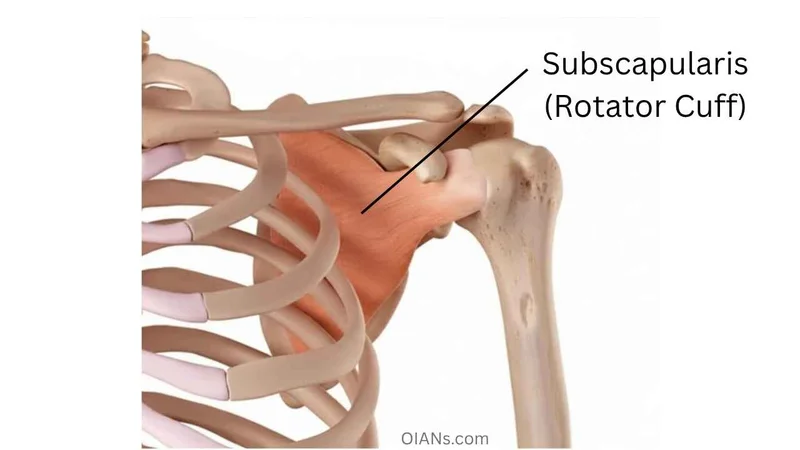
Origin, Insertion, Action & Nerve
Origin
Subscapular fossa (costal surface of scapula)
Insertion
Lesser tubercle of humerus
Action
Medial (internal) rotation of arm; stabilizes glenohumeral joint
Nerve
Upper and lower subscapular nerves (C5, C6)
Attachments explained
The Subscapularis (Rotator Cuff) is defined first by where it attaches. Its origin is the more fixed anchor, usually the proximal or more stable end that stays put during contraction, while its insertion is the more mobile point that is pulled toward the origin when the muscle shortens.
Origin
Subscapular fossa (costal surface of scapula)
Insertion
Lesser tubercle of humerus
Action & function
When the Subscapularis (Rotator Cuff) contracts, it produces the following movements: Medial (internal) rotation of arm; stabilizes glenohumeral joint.
As part of the Shoulder & Scapula group of the Upper Limb, it works alongside neighbouring muscles to generate smooth, coordinated movement and to stabilise the structures it acts on.
Nerve supply & clinical relevance
The Subscapularis (Rotator Cuff) receives its nerve supply from the Upper and lower subscapular nerves (C5, C6). This nerve carries fibres from spinal segment(s) C5, C6.
Because a muscle can only contract when its nerve is intact, injury to the Upper and lower subscapular nerves or to its spinal roots (C5, C6) can weaken or paralyse the Subscapularis (Rotator Cuff), impairing the movements it normally produces (medial (internal) rotation of arm). This is why knowing the innervation is central to localising nerve lesions in clinical practice.
How to study the Subscapularis (Rotator Cuff) (the OIANS method)
Set subscapularis apart from the other three cuff muscles on two counts: it lies on the front (costal) surface of the scapula, and it is the only one to insert on the lesser tubercle. Both facts point the same way, toward medial rotation, so once you know it sits in front and pulls the lesser tubercle forward, its action is self-explanatory.
Use the lift-off test as a mental peg: the hand is placed behind the back and pushed away, isolating internal rotation. Connect that to its bracing of the front of the joint and its supply by the subscapular nerves, and you have origin, action, and nerve bundled into one clinical picture.
Frequently asked questions
Where is the Subscapularis (Rotator Cuff) located?
The Subscapularis (Rotator Cuff) is a muscle of the Shoulder & Scapula group, located in the Upper Limb.
What is the origin of the Subscapularis (Rotator Cuff)?
Subscapular fossa (costal surface of scapula)
What is the insertion of the Subscapularis (Rotator Cuff)?
Lesser tubercle of humerus
What movements does the Subscapularis (Rotator Cuff) produce?
Medial (internal) rotation of arm; stabilizes glenohumeral joint
What nerve supplies the Subscapularis (Rotator Cuff)?
Upper and lower subscapular nerves (C5, C6)
Is the Subscapularis (Rotator Cuff) free to study in OIANS?
Yes. The Subscapularis (Rotator Cuff) is free in OIANS: its full origin, insertion, action and nerve details are open to everyone in the Muscle Directory, and because it belongs to the Upper Limb it is also covered by the free Quiz and Flashcard decks. The other regions, the "All Muscles" deck, and the Progress and Explore tools are unlocked with a one-time Lifetime purchase.
Related muscles
Study the Subscapularis (Rotator Cuff)
Test yourself on Upper Limb muscles with interactive quizzes and flashcards in the free OIANS app.
Quiz yourself → Flashcards Open the OIANS app
Browsing is always free. A one-time Lifetime unlock adds every region's quizzes, flashcards, progress tracking and explore tools.